MayneLiner January 2026
Water Scarcity – Fiction and Fact – By Robin Walsh
I’m writing this while Mayne is experiencing another atmospheric river of rain, but visions of summer drought are ever present. I just finished reading Louise Penny’s latest novel “Black Wolf”, (available at the Mayne library) which although fiction, the underlying tension reflects something very real: shifting geopolitical pressures as resources become scarcer. In this case, it’s water and the United States.
Across the U.S., water shortages are an economic and political challenge. The Colorado River Basin, which supports roughly 40 million Americans, has been strained by decades of overuse coupled with climate-driven drought. States such as Arizona, Nevada, California, and parts of New Mexico are already facing periodic emergency restrictions. Meanwhile, aquifers from the Midwest to the Southwest are being drawn down far faster than they can recharge.
These pressures are likely to intensify. As American demand for water increases while supply shrinks, policymakers and strategists are beginning to consider scenarios that once seemed unthinkable: what happens when the existing sources simply cannot meet national needs?
This is where Canada enters the conversation—not as an adversary, but as the world’s steward of a disproportionate share of fresh water.
Canada holds nearly 20% of the planet’s freshwater resources, although only a fraction is easily accessible or renewable. Nevertheless, to a water-stressed world, Canada appears uniquely water-rich.
Historically, the idea of large-scale water exports to the U.S. has surfaced periodically, from proposals to divert northern rivers to debates over pipelines that would send water south. Successive Canadian governments—federal and provincial—have rejected these schemes, citing environmental risks, Indigenous rights, and political sovereignty.
Nonetheless, as American water scarcity worsens, the pressure on Canada may grow—not necessarily through confrontation, but through economic leverage, trade negotiations, or the gradual normalization of the idea that Canada should “share” more of what it has.
Penny’s “Black Wolf” captures the unease that arises when a powerful neighbour feels it has limited options. While her story is imagined, it contains some warnings that we need to heed especially since President Trump said recently that a very large faucet in Canada could be turned on to divert millions of gallons of water to California.
But Canada also has drought problems which extended across the country last summer including rural Nova Scotia, eastern Ontario, parts of the Prairies and BC to name a few places.
This means that in addition to the potential demand for water to be sent south of the border, we have to respond to water scarcity in regions of our own country.
For us on Mayne, it means being good stewards of our freshwater by protecting its sources (our five aquifers) and conserving our supply to ensure we have enough water for all during the dry summer months. Currently, when our wells are stressed, water can be trucked in from Vancouver Island. But what will that supply look like in the future? Who’s writing that novel?
MayneLiner December 2025
Taking Care of Your Own Well – By Robin Walsh
With the fall rains making their way into our island aquifers (slowly!) it gives us some comfort that we’ll have enough water for household use next summer. But that’s only half the story – we need to ensure that our groundwater source is safe to drink.
All the water districts on Mayne test their water regularly for e-coli and also for metals and the test results are published on the Island Health website. However, if you are not part of a water district and your drinking water is supplied from a private well on your property, you too should be testing your water regularly for e-coli and metals. Here’s what you need to do.
Testing your water for e-coli
Private well operators should be testing their water annually if not more often for e-coli. Information on how to take a water sample can be found on the MB Labs website. You will need a sterilized bottle, and the 200 mL sample must be delivered within 30 hours of collection to MB Labs in Sidney.
Testing your water for metals and minerals
Private well operators should be testing their water every couple of years for metals. These tests will identify 33 elements, pH and hardness. This requires a sample volume of 500 mL in a sterilized bottle and the sample must arrive at MB Labs in Sidney within 48 hours of collection.
Getting help with testing
If you need help with testing your well water, contact us at miwatersociety@gmail.com and Bill Warning will provide assistance with the test. You can either deliver the sample yourself to MB Labs in Sidney or contact Jeanine Dodds courier to have it delivered. Sample bottles can also be picked up at our Home Hardware store and they will also deliver the sample to MB Labs if they get your sample on Wednesdays. Drop by the HH and get your bottle and form. Testing well water for e-coli and metals provides peace of mind about the safety of the drinking water and also about the level of elements that could be important to personal health.
Protecting our groundwater
We all have a responsibility to protect our groundwater that is the source of drinking water for most people on Mayne. Proper location of septic tanks and fields and maintaining them is key. While we live in a rural community, there are still rules and regulations to follow that are designed to protect you and your neighbours.
MayneLiner November 2025
Where’s the Sustainable Water Supply Plan? By Robin Walsh
Islands Trust is proposing changes to its bylaws to increase the number of houses allowed on smaller lots on Mayne. While intended to help create affordable housing (a worthy goal) these changes unfortunately are very problematic for those water districts that would be directly affected. It could also have serious implications for properties on Mayne that currently rely on the island’s five aquifers for potable water, which is almost all properties.
Several of the water districts directly affected by these proposed changes have their own bylaws prohibiting secondary water system connections on a property. That is, only one connection is permitted per property. Furthermore, for some districts each connection is restricted to a set monthly amount of water consumption.
As one water district says, “any further increase in population density within our Improvement District could result in a catastrophic shortage of domestic water.”
The provincial government is pressuring local jurisdictions to implement policies to increase housing stock in the hopes of addressing housing affordability. However, what they fail to recognize is that communities like ours have significant limitations when it comes to sourcing potable water for our current residents, not to mention a future increased population. Our drinking water doesn’t flow from lakes and rivers but is solely reliant on rainfall percolating into the ground and being stored in our aquifers. We are all drawing from the same source of water under the ground regardless of whether you are in an established water district or have your own well. For more information about our aquifers, see Groundwater page.
What is missing in the Islands Trust proposal is any proof that our groundwater supply can sustain the proposed increase in population.
We already have serious droughts each summer and these will likely worsen with climate change. Our island residents are aware of water restrictions and conservation measures and take these very seriously. Our water districts understand how important this is to ensure potable water is available for everyone. What is also missing in the Islands Trust proposal are any serious measures for conservation or for use of rainwater in new builds. They will prohibit filling swimming pools from groundwater, something already banned by water districts, and they propose small freshwater cisterns for new builds but an average household would use that water in less than two months. Islands Trust could insist on new builds being self-sufficient with rainwater, something that is cost comparable to a new well.
While we all do our best to take short showers, use rainwater for our gardens, and check for leaky toilets, the powers that be want to put further strain on our drinking water supply without any evidence that this is sustainable or have a serious plan for use of alternative water sources. Our water districts are already challenged with infrastructure costs so before governments move ahead to increase the population on Mayne, they need to make a long-term commitment to funding a sustainable potable water supply.
MayneLiner July 2025
Conservation, Leaks, and Rainwater By Robin Walsh
I grew up in Ontario near Niagara Falls surrounded by the Great Lakes. There was such an abundance of water that we never worried about having enough. No one even discussed it. We used municipal water with abandon on our lawns, in our pools, and to wash our driveways. Drought was somewhere else, but not in Canada or at least not in our part of Canada.
Fast forward 60 years and here I am on Mayne Island with water and drought a common topic of conversation, particularly during the summer. There are no waterfalls or lakes giving us our source of drinking water. We depend on the rain that has percolated into the ground during the winter. But is there enough water in the ground for everyone? We just don’t know so that’s why together we have to be very prudent in our use of water.
Conservation is key: All the water districts on Mayne promote it. You see their signs around the island that encourage us to conserve water, follow the water use restrictions, and turn off our water when away for more than a day. Hopefully these messages “percolate” through to the majority of residents. Check with your water district about water use limits, restrictions, and requirements.
Leaks are our enemy / meters are our friend: In Bennett Bay Water District we read our household water meters monthly and we find that a spike in water use in a household is usually the result of a leak. And often the leak is a leaky toilet. Toilet leaks can be silent, which makes them hard to detect, and are usually caused by a worn or misaligned part.
A toilet that continues to run after flushing could be wasting 20–40 litres per hour.
Meters also helped us find a major leak at a property in winter. A hose with water in it froze and then split with the thaw and the water was on with nobody home. We were able to find the leak by checking household meters. I can’t imagine how much water would have been lost if we didn’t have meters to locate the leak and shut off the water.
Rainwater use: It can’t be said enough that you should not use groundwater on your garden or to wash your deck, boat, or vehicle – only use collected rainwater. If you don’t have any rainwater tanks, drop by the Home Hardware and get one or two. There are experts on island who can help install them and Transition Salt Spring offers rebates on tanks.
Remember, every drop counts!
MayneLiner June 2025
Drought and Groundwater Data by Robin Walsh
Have you started watering your garden already? Some gardeners tell me that they began tapping into their collected rainwater in early May, weeks earlier than usual for watering their gardens. We expect dry conditions in the summer but is this now something to expect earlier in the growing season?
Drought Levels
While anecdotal evidence is an interesting source of information it is often incomplete and sometimes inaccurate. Some of us might go to Facebook for information but we’re not likely to find solid answers there. So, where do we turn to find data about what is happening around drought conditions? Fortunately, there is information collected by the BC government and we can access it through their Drought Information Portal.
The Province monitors snow pack melt, river flows, and rainfall. For Mayne, rainfall determines our drought conditions. Contrary to the old myth, our five island aquifers are not replenished by snow melt from Mount Baker; our groundwater is recharged from rainfall that percolates into the ground.
The Province uses a six-level classification system to assess drought conditions (Level 0 = no drought / Level 5 = severe drought). At the time of writing this article (mid-May) our region was at Level 3 drought. In 2024 we didn’t reach Level 3 until mid-July. The Province states that the drought conditions do not consider forecasted weather conditions. The recent rains can of course change our level of drought. To find this data, go to BC Drought Portal.
Groundwater Levels
While having enough water for our flowers and vegetables is important, what do we know about the well water we depend on for drinking, cooking, and brushing our teeth? The conversations at the Mayne Bean can be informative but we might want to dig a little deeper.
Again, the Province is a good source of scientific data.
They maintain a network of groundwater observation wells to monitor water levels in priority aquifers, and we have one of these wells on Mayne.
It records in real time water level fluctuations which allow for improved understanding of how aquifers respond to changes in climate, precipitation, and effects from pumping.
The ground water data collected is compared to historical continuous daily records and then given a water level classification from low to high. As of mid-May, the water level in the observation well on Mayne was classified as normal. This is helpful information when it comes to knowing how much water is below the ground in the aquifers, which are our source of water for the over 10 water districts on island and for the properties that source water from their own well. Several of the water districts also measure their well water levels and we know from experience that these levels drop during the dry summer months when the demand for water is the highest.
To find the website with Mayne’s observation well, go to West Coast Region Groundwater Level Conditions.
Soak up the data and remember every drop counts!
MayneLiner May 2025
The Water People of Mayne by Robin Walsh
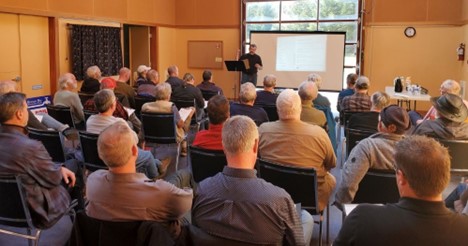
When you turn on the tap to brush your teeth, fill a glass, or take a shower, do you think about where the water comes from and how it gets to your house?
Maybe you do sometimes but luckily there are people on Mayne who think about it all the time and they are preoccupied with the quality and quantity of water flowing through the pipes. But they do more than think about it, they work hard to maintain the island water systems that include wells, pumps, tanks, pipes, meters, and of course water treatment.
Just who are these water people?
Do they have a secret handshake and meet on the deck of the Springwater during a full moon?
Not likely, but they are dedicated individuals who care about potable water and are involved in one of the over 10 water districts on Mayne. They are either volunteers on a water district Board of Trustees or they are part-time staff running the day-to-day operations including the water system operator who is key to keeping the water flowing and safe to drink. Two water districts are managed by the CRD but still have local involvement.
Recently, over 40 of these dedicated water district people got together at the Community Centre to hear from experts on subjects related to managing a water district. The workshop was hosted by the MIWSS. Each water district is independent yet has similar operations and challenges so it makes sense that we come together to share information, support each other, and work together – and the MIWSS is making that happen. Here’s who presented and what was discussed:
Rob Noyes, water operator, shared his experiences in finding leaks and the various techniques and equipment he has used. We’re now looking at collectively purchasing some of this equipment and training someone on island to use it so we don’t have to rely on off island help when there’s a leak in a water system.
Kyle Stobbart, Fire Chief, reminded us of the importance of district water when there’s a fire.
Red Williams, well expert, spoke about locating a new well and the cost. He also discussed wells with salt water intrusion and the possibility of having them return to service.
Sean Skiffington, water technology expert, presented how two water districts are using computer technology to manage their systems. Other districts are now considering this as they modernize.
There were also discussions about water districts needing help with administration and accounting, how we can support each other, and also collaboration.
So next time you turn on your tap, give a little thanks to the dedicated water people of Mayne.
 miwss
miwss 